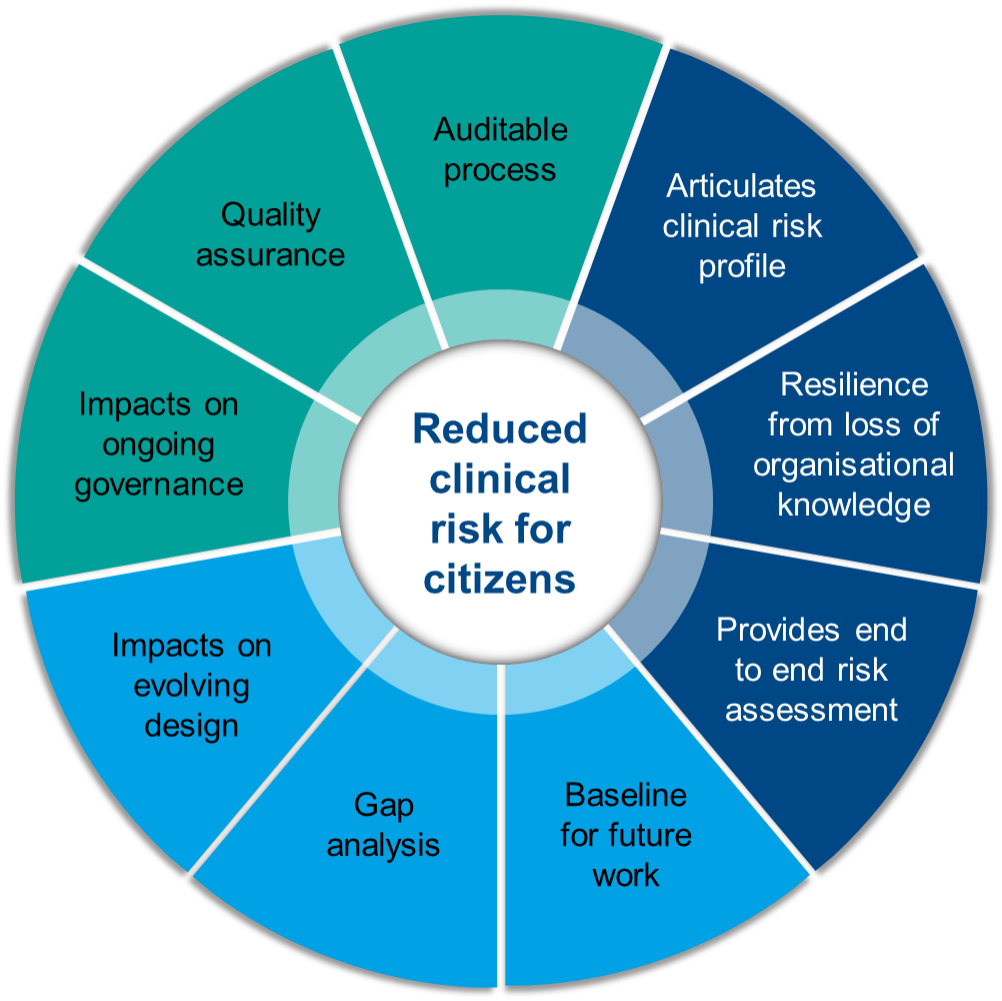
The increased complexity and involvement of software within the healthcare landscape of Scotland brings new and increased risks to patients. Recent news articles have highlighted that software can cause as much harm as any other tool or individual in the field, often on a much larger scale due to the efficiency and reach of these programs. Systems can cause widescale impacts to patients, and thus it is paramount that system manufacturers, owners, and deploying agencies ensure that their system is as safe as possible.
How can this be achieved? As an organisation it can be difficult to get an unbiased and transparent clinical risk summary of a system, particularly when there is a fundamental difference in the way IT staff and developers view a problem when compared to how a Clinician views the same problem. Our Clinical Safety Case (CSC) teams function outside of your programme, providing the ability to deliver an honest and neutral clinical risk profile that is understandable by all levels of a programme. We bring a multi-disciplinary team comprising Clinical Safety Officers (CSOs) and Clinical Safety Engineers (CSEs) from a variety of backgrounds to examine your digital solution through a clinical lens. This provides peace of mind for a Programme Board, and the tools to proceed with an eyes-open approach.
Conducting a CSC for digital solutions in healthcare has been the law in England since 2012, and is recommended as part of the new Digital Health and Care Strategy in Scotland. NCISS use the most up-to-date ISO 14971 standard to conduct our product-based risk management process, allowing for an effective benefit versus risk analysis for each area of your system. This results in a fully auditable Clinical Risk Management File (CRMF), proving your due diligence to your patients has been done, and allowing for ongoing monitoring of clinical safety throughout the lifecycle of your software or system.